The Lady Chapel Window: A Story Written in Glass
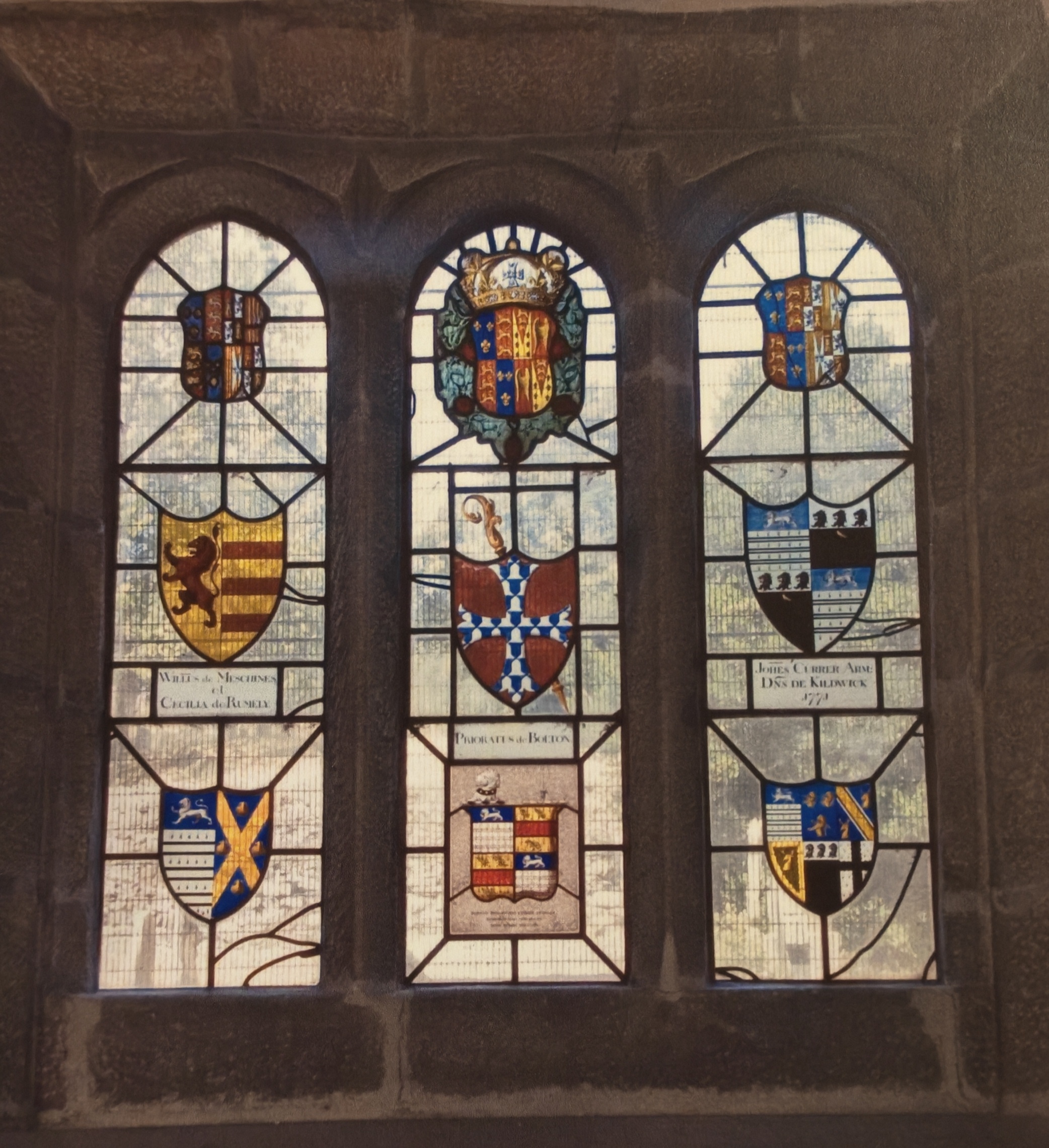
Most visitors to St Andrew's Kildwick notice the great east window, with its colourful figures looking down towards the altar. Yet tucked away in the northern part of the church is another window whose story reaches much further into Kildwick's past.
At first glance, it might seem an unremarkable collection of colourful coats of arms. Look more closely, however, and an extraordinary story begins to emerge. Here, preserved in glass, are connections to Tudor kings and queens, the founders of Bolton Priory, and the families who shaped Kildwick over hundreds of years.
The window belongs to the area traditionally known as the Currer Chapel, now generally called the Lady Chapel. As we discovered in our previous article, The Chapel with Many Names, this part of St Andrew's has undergone several changes of name and purpose.
Its stained glass provides another way of understanding that history, preserving the names and connections of people who might otherwise have been forgotten.
Nine Shields, Centuries of History
The window consists of three tall lights, each containing three heraldic shields.
Across the top are three royal coats of arms. Below them are shields commemorating the medieval founders of Embsay Priory, Bolton Priory itself, and the Currer family. The bottom row contains further family heraldry, including connections established through marriage and inheritance.
It is almost like a family tree, although one which reaches far beyond a single family.
The arrangement is particularly interesting because the shields represent people and institutions from very different periods. Some recall the twelfth century, others the Tudor period, and still others the eighteenth and early nineteenth centuries.
Yet they have been brought together into one composition.
To understand why, we need to read the window from the top down.
Royal Connections
Perhaps the most surprising feature of the window is the royal heraldry occupying its uppermost row.
Among the shields identified by the Revd E. W. Brereton in his 1909 history are those of Philip II of Spain and Mary I of England, and Henry VIII and Jane Seymour.
Mary I married Philip of Spain in 1554, while Jane Seymour became Henry VIII's third wife in 1536. These were momentous years in English history, as the country experienced the religious upheavals of the Reformation.
The central shield is particularly striking, with its elaborate royal crown and richly coloured quarterings.
The presence of these arms raises an intriguing question. Why should royal heraldry associated with the Tudor court appear in a parish church in Craven?
We cannot say with certainty what circumstances originally brought every shield to Kildwick. Nevertheless, their preservation reflects the importance attached to royal authority, patronage and historical memory.
Brereton noted that the window included both older and more modern heraldic glass. It would therefore be misleading to assume that every royal shield dates from the reign of the monarch it commemorates.
The window is not simply a Tudor survival. It is a collection assembled and altered over time.
Cecilia de Romille: A Name from the Twelfth Century
Moving down to the middle row, the shield on the left takes us back considerably further, to the beginnings of one of Yorkshire's most celebrated religious houses.
Beneath a gold shield bearing a red lion and horizontal bars, an inscription names William de Meschines and Cecilia de Rumely.
Cecilia, generally known today as Cecilia de Romille, was an important figure in the history of medieval Craven.
Together with her husband, William de Meschines, she was associated with the foundation of Embsay Priory in about 1120. The Augustinian community later moved to Bolton, where it became the religious house we know today as Bolton Priory, or Bolton Abbey.
Cecilia's connection with Kildwick is particularly significant.
Her grants helped establish the relationship between the priory and the lands at Kildwick, a connection which would influence the church and parish for centuries.
It is remarkable to think that the name of a woman associated with the beginnings of Bolton Priory can still be read in the glass at St Andrew's.
Of course, Cecilia herself did not commission this particular window. The shield is a later commemoration of her and her husband, not a surviving piece of twelfth-century glazing.
Nevertheless, it preserves the memory of someone whose decisions helped shape the religious landscape of the Aire Valley.
Bolton Priory Remembered
The central shield in the middle row continues the story.
It features a decorative cross, with a pastoral staff rising behind it. Beneath are the words Prioratus de Bolton, meaning Bolton Priory.
For medieval Kildwick, Bolton was no distant institution.
The Augustinian canons were closely connected with the church, its lands and its religious life. Their influence extended across the surrounding countryside, and their relationship with Kildwick continued for centuries.
That world changed dramatically during the dissolution of the monasteries under Henry VIII in the sixteenth century. The priory's religious community was dissolved, and the administration and ownership of its property changed.
Yet here, in the Lady Chapel window, the memory of Bolton Priory remains.
The placement of Cecilia's shield beside that of the priory is especially fitting. Together, they commemorate both the people associated with its foundation and the religious institution that grew from those beginnings.
The Currers of Kildwick
The third shield in the middle row brings the story much closer to home.
Its inscription identifies John Currer, Lord of Kildwick, and bears the date 1771.
The Currer family became closely associated with Kildwick Hall and the manor, and their influence can still be traced throughout the church and village.
The window contains several references to the family and its connections through marriage, including the Richardson, Wade and Roundell families.
One shield recalls Henry Currer, who married Ann Wade and died in 1568. Others represent the complicated network of family relationships and inherited estates.
Heraldry was an important means of recording such connections.
To someone familiar with the language of coats of arms, the colours, symbols and combinations of shields could communicate family history without the need for lengthy inscriptions.
And the story of the window itself is closely linked to another member of the Currer family.
The Man Who Brought the Glass Together
An inscription recorded by Brereton identifies Danson Richardson Currer as the person who placed the window in 1808.
This is a crucial detail.
Although several shields commemorate much earlier people, the arrangement we see belongs to a later chapter of the church's history.
The early nineteenth century saw a growing interest in antiquarian research, family history and the preservation of historic objects.
By bringing together heraldic glass associated with different periods, Danson Richardson Currer helped preserve and display connections between Kildwick's past and the families who had shaped it.
The window became more than decoration. It was a statement about history, identity and remembrance.
There is something particularly fitting about that in a chapel which was itself so closely associated with the Currer family.
A Window That Has Changed
One of the difficulties with interpreting historic stained glass is that windows do not always remain as they were originally installed.
Panels can be moved, repaired, replaced or incorporated into entirely new arrangements.
That is especially important at Kildwick.
Historical descriptions distinguish between older and newer glass, while the modern stained-glass survey confirms that the Currer heraldic window has a complicated history.
There is also a separate eastern window in the chapel which should not be confused with this heraldic composition.
During the restoration of 1901–1903, an eastern opening which had previously been blocked was reopened, with new mullions and cathedral glass installed.
The distinction matters. The Lady Chapel has not retained one untouched collection of medieval glass. Instead, it bears witness to successive generations altering, preserving and sometimes reconstructing the past.
That does not make the window less interesting.
In many ways, it makes its story richer.
Reading the Past in Glass
It is easy to walk past heraldic windows without giving them much attention.
Unlike biblical scenes, their meaning is not immediately obvious. We may recognise a crown or a cross, but the significance of individual shields and inscriptions can easily escape us.
Yet this window tells an extraordinary story.
It takes us from the royal marriages of Tudor England to the foundation of Embsay Priory, from the Augustinian canons of Bolton to the Currers of Kildwick Hall.
It reminds us of the families who held land, endowed religious institutions and helped shape the community over many generations.
Above all, it reminds us that the history of a church is not simply the story of its stones.
St Andrew's has been altered, repaired and reordered many times during its long history. Its windows have changed too. But through those changes, successive generations have continued to find ways of remembering those who came before them.
Next time you visit the Lady Chapel, take a moment to look at the window.
Start with the royal shields at the top. Find Cecilia de Romille's name on the left, Bolton Priory in the centre, and John Currer on the right.
Then look at the further shields beneath them, each preserving another connection with the families of Kildwick.
For there, in nine colourful coats of arms, is another remarkable chapter in the story of the Lang Kirk of Craven of Craven.
17/11/2026