The Day Kildwick's Bells Rang Out
The remarkable story of the first peals at St Andrew's, 1780
On Saturday 6 May 1780, Kildwick witnessed something rather extraordinary.
People gathered around St Andrew's Church to hear six newly installed bells ring out from its medieval tower. The bells had been cast in London, transported to Yorkshire and carefully hung in preparation for their public opening.
But this was to be much more than a ceremonial ringing of the bells.
Two accomplished teams of bell-ringers, one from Bingley and the other from Keighley, had travelled to Kildwick. Each would attempt a remarkable feat of endurance, concentration and coordination: ringing 5,040 changes without repeating a sequence within each extent.
And both succeeded.
Their achievement was reported in the Leeds Intelligencer, allowing us to reconstruct a remarkable day in the history of St Andrew's, and to correct a longstanding misunderstanding about when the church's first full-length peals were rung.
Before the new bells
Bells had been ringing at Kildwick long before 1780.
The earliest surviving churchwardens' accounts, dating from 1672–73, tell us that St Andrew's possessed three bells. These were rung from ground level by four ringers, including the sexton.
The bells were an important part of village life. They summoned parishioners to worship, helped mark the passage of time and announced occasions of national importance.
The church accounts record ringing to celebrate military victories, royal accessions and other significant events. During the War of the Spanish Succession, for example, the bells marked the victories at Blenheim, Ramillies and Oudenarde.
They were evidently well used. The churchwardens regularly paid for repairs to the bells, their wheels, ropes and fittings, much of the work being undertaken by the local blacksmith.
By the late eighteenth century, however, the parish was ready for something more ambitious.
Six new bells from London
In 1779–80, six new bells were commissioned from Pack and Chapman, bellfounders at the famous Whitechapel foundry in London.
The task of hanging them was entrusted to Samuel Turner, a professional bell-hanger from Whitechapel.
Turner was already familiar with Yorkshire. Six years earlier, in February 1774, he had hung a new ring of bells at Bingley. He would subsequently undertake work at several other Yorkshire churches, including Otley.
The new Kildwick bells formed a ring of six, with the largest weighing approximately ten hundredweight, around half a tonne.
Each carried the name of its founder and the date 1780, together with inscriptions commemorating people associated with the parish. The tenor bore the names of the vicar, Revd J. Dehane, and churchwardens Robert Spencer and John Booth. The other bells commemorated churchwardens William Lee, Francis Stirk, Samuel Slack, Peter Smith, John Watson and William Cockshott.
A new floor was installed in the tower, allowing the bells to be rung from an elevated ringing chamber rather than from ground level.
St Andrew's now possessed a ring suitable for the increasingly sophisticated art of change ringing.
An invitation to hear the bells
The opening was announced in the Leeds Intelligencer on Tuesday 2 May 1780, just four days before the event.
The advertisement identified Pack and Chapman as the founders and Samuel Turner as the man responsible for hanging the bells. It also announced that Turner would be present at Kildwick on the opening day and available to speak to anyone interested in his services.
The occasion was therefore both a public celebration and an opportunity for the bell-hanger to demonstrate his craftsmanship.
On Saturday 6 May, people gathered to hear the new bells.
The newspaper subsequently reported that a large crowd had assembled.
We cannot know exactly what the village looked or sounded like that morning, but we can imagine the anticipation as people waited around the church for the first performance on the new bells.
What is a peal?
To appreciate what happened that day, it helps to understand a little about change ringing.
Church bells rung in changes do not play a tune in the usual musical sense. Instead, the ringers continually alter the order in which the bells sound, following carefully learned mathematical patterns known as methods.
With six bells, there are 720 possible arrangements of their ringing order.
A complete sequence of these 720 arrangements is called an extent.
By ringing seven extents, using different methods or variations, a band can produce 5,040 changes, the traditional length of a full peal.
It is an extraordinary test of concentration and physical endurance. Each ringer must control a heavy swinging bell with precision, maintain the correct rhythm and follow the changing order for several hours.
There is little room for error.
Two teams, two remarkable performances
The first visiting society came from Bingley.
This was a particularly appropriate choice. Bingley already had an established tradition of change ringing, and its ringers were familiar with bells installed by Samuel Turner, who had hung their own bells in 1774.
According to the newspaper report, the Bingley society completed 5,040 changes in three hours and two minutes.
Then came the ringers from Keighley.
Remarkably, they completed the same number of changes in exactly the same time.
The Leeds Intelligencer of 16 May 1780 recorded both performances and reported that the new bells had given general satisfaction.
It must have been an extraordinary occasion for a small Yorkshire village. Two visiting bands had each spent more than three hours demonstrating their skill on the new installation.
Unfortunately, the newspaper did not record the individual ringers' names or the precise methods they rang. But it preserved the essential details: the date, the visiting societies, the number of changes and the duration of both performances.
More than two centuries later, those details allow us to establish that Kildwick's new bells were inaugurated with two full-length peals.
Were these really Kildwick's first peals?
For many years, accounts of the bells have identified 18 September 1896 as the date of the first full peal at St Andrew's.
That performance, consisting of 5,040 changes rung in three hours and two minutes, is commemorated on a handsome peal board in the tower.
It was undoubtedly an important achievement, but the contemporary newspaper evidence reveals that two performances of the same length had already taken place more than a century earlier.
The specialist Felstead Database, which preserves historical records of church bell-ringing, recognises both performances of 6 May 1780 as peals.
The 1896 performance is therefore the earliest recorded on the surviving peal board, but it was not the first full-length peal documented at St Andrew's.
That distinction belongs to the visiting societies from Bingley and Keighley in 1780.
Kildwick's own ringers take up the challenge
The story does not end with the opening celebrations.
Just two years later, on 29 May 1782, Kildwick's own society of ringers completed 5,040 changes in three hours and forty minutes.
Their performance celebrated the anniversary of the Restoration of Charles II and was reported in both the Leeds Mercury and the Leeds Intelligencer on 11 June.
This is a particularly satisfying development in the story.
In 1780, accomplished visiting ringers had demonstrated what the new bells could do. By 1782, Kildwick's own ringers were capable of a substantial performance themselves.
And the connections between neighbouring ringing societies continued.
In September 1783, the Leeds Mercury reported that a society of ringers from Keighley and Kildwick had completed another 5,040 changes at Keighley, taking three hours and forty minutes.
These records reveal something of a flourishing local ringing community, with societies travelling between neighbouring churches, sharing their expertise and celebrating one another's achievements.
The opening of Kildwick's bells was not simply a memorable day in 1780. It marked the beginning of a new chapter in the village's ringing tradition.
The bells ring on
The six bells installed in 1780 served St Andrew's for more than 130 years.
They witnessed generations of village life: Sunday worship, weddings, funerals, national celebrations and the changing fortunes of the surrounding communities.
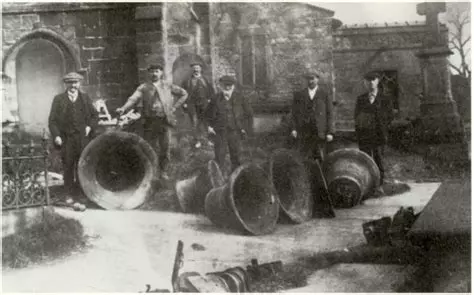
In June 1914, the bells were removed and taken to John Taylor and Company's foundry in Loughborough, where they were recast.
Two additional bells were provided, creating the ring of eight that hangs in St Andrew's today.
The original 1780 inscriptions were preserved on the six recast bells, maintaining a tangible connection with the eighteenth-century parishioners who had commissioned them.
The new bells were dedicated by the Bishop of Knaresborough on 28 October 1914, just months after the outbreak of the First World War.
On 4 March 1916, another milestone was reached when a band completed 5,088 changes of Kent Treble Bob Major, the first full peal on the new ring of eight.
Among the ringers were Christopher Brown, Charles Law and John Hill, all of whom had participated in earlier peals on the six-bell ring.
The tradition had continued into another generation.
A day worth remembering
Today, when the bells of St Andrew's ring out across Kildwick, they continue a tradition documented as far back as the seventeenth century, and quite possibly much further.
But Saturday 6 May 1780 deserves a special place in that history.
It was the day when six new bells, cast in London and hung by a skilled craftsman, were heard in public for the first time.
It was the day when two teams from neighbouring Yorkshire towns each completed 5,040 changes, both taking exactly three hours and two minutes.
And it was the beginning of a remarkable period in which Kildwick's own ringers established themselves within a flourishing Yorkshire tradition of change ringing.
The bells themselves have changed, but the tradition has endured.
More than two centuries later, the surviving newspaper reports allow us to rediscover something of the excitement of that extraordinary Saturday in May.
And every time the bells ring, another chapter is added to their story.
03/11/2026